You might at first think that any matrix multiplication algorithm must take o(n^3) time, since the natural definition of matrix multiplication requires that many multiplications. You would be incorrect, however: we have a way to multiply matrices in o(n^3) time.
在没学习这章之前,我确实是这么想的,我认为矩阵相乘这个问题本身的复杂度就是o(n^3),不存在“捷径”,但是这里的Strassen’s algorithm居然能将矩阵相乘的复杂度降到o(n^2.81),简直匪夷所思,是如何做到的?
normal solution
在提到矩阵相乘的时候我们一般都是用这种方法,很符合我们的思维习惯,也是我们最开始学习矩阵的时候会接触的方法。

伪代码是:
//Algorithm:SQUARE-MATRIX-MULTIPLY(A,B)
n=A.rows
for i=1 to n
	for j=1 to n
		c[i][j]=0 //save every element
		for cnt=1 to n
			c+=a[i][cnt]*b[cnt][j]
return C
不难分析,三层循环,时间复杂度是O(n^3)
a simple Divide-and-Conquer solution
有学习过线性代数的同学都知道矩阵有所谓的“分块乘法”,我们可以将大矩阵看成2x2矩阵,这就变成了原问题的一个子问题,递归解决即可。
//Algorithm:SQUARE-MATRIX-MULTIPLY-RECURSIVE(A,B)
n=A.rows
let C be a new n x n matrix
if n==1
	C[1][1]=A[1][1]*B[1][1]
else partition A,B to C11,C12,C21,C22
	C11=SQUARE-MATRIX-MULTIPLY-RECURSIVE(A11,B11)+SQUARE-MATRIX-MULTIPLY-RECURSIVE(A12,B21)
	C12=SQUARE-MATRIX-MULTIPLY-RECURSIVE(A11,A12)+SQUARE-MATRIX-MULTIPLY-RECURSIVE(A12,B22)
	C21=SQUARE-MATRIX-MULTIPLY-RECURSIVE(A21,B11)+SQUARE-MATRIX-MULTIPLY-RECURSIVE(A22,B21)
	C22=SQUARE-MATRIX-MULTIPLY-RECURSIVE(A21,B12)+SQUARE-MATRIX-MULTIPLY-RECURSIVE(A22,B22)
return C
它的recurrences是:

如果用后面会学到的master method,可以知道这个算法的复杂度是Θ(n^3)。
但还有一点需要注意的是,这里的矩阵分块具体如何实现呢?分别为A,B,C创建4个子矩阵也就是一共12个矩阵吗?这样会额外消耗Θ(n^2)时间复制矩阵,我们可以使用指定下标的方式给定子矩阵,具体请读者自行研究。
那么它recurrences的f(x)部分是Θ(n^2),就是上面复制矩阵而消耗的额外时间吗?不是,无论是使用复制矩阵的Θ(n^2)方法还是后者的Θ(1)方法,recurrences的Θ(n^2)都是存在的,原因是这一部分其实是矩阵相加所带来的
消耗,每个子矩阵是n/2 x n/2 也就是n^2/4个元素,4个子矩阵一共有n^2次相加。
Strassen’s Algorithm
Strassen’s Algorithm的具体做法是:
- Divide the input matrices A and B and output matrix C into n/2 * n/2 submatrices。 This step takes Θ(1) time by index calculation, just as in SQUARE-MATRIX-MULTIPLY-RECURSIVE. 将矩阵分块,这一部分和前面的一样。
- Create 10 matrices S1,S2…S10, each of which is n/2 * n/2 and is the sum or difference of two matrices created in step 1. We can create all 10 matrices in Θ(n^2) time.创建10个新矩阵,这10个矩阵由4个子矩阵相乘或相减
所得,根据前面的经验,这一部分应为Θ(n^2)。
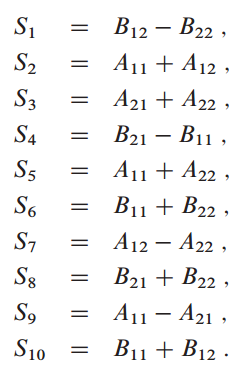
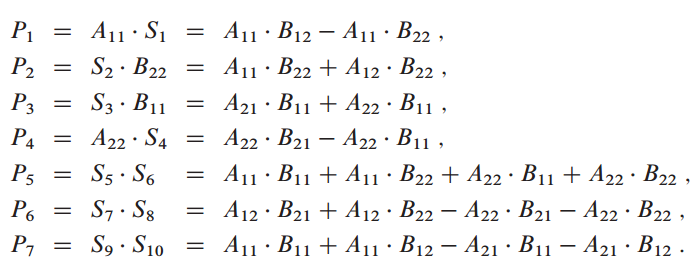
- Using the submatrices created in step 1 and the 10 matrices created in step 2,recursively compute seven matrix products P1,P2…P7 Each matrix Pi is n/2 * n/2. 用上面创建的10个矩阵和原来的4个子矩阵运算得到P1-P7。
-
Compute the desired submatrices C11,C12,C21,C22 of the result matrix C by adding and subtracting various combinations of the Pi matrices. We can compute all four submatrices in Θ(n^2) time.用P1-P7运算得到C11,C12,C21,C22。
C11=P5+P4-P2+P6
C12=P1+P2
C21=P3+P4
C22=P5+P1-P3-P7
经过上述4步,Strassen’s Algorithm成功完成了矩阵相乘,它的recurrences是:

算法的复杂度用master method得Θ(n^log7)。
我原本以为,Strassen’s Algorithm是发现了传统的分块乘法有“信息的冗余”,也就是说在传统的分块乘法里有“重复计算”,才降低了复杂度,但是实际上不是这样,Strassen是把A*B+A*C变成了A*(B+C),前者先计算A*B再计算
A*C,再相加,经过了两次相乘一次相加,而后者先相加再相乘,经过了一次相乘和一次相加。
Exercise
4.2-3
How would you modify Strassen’s algorithm to multiply n*n matrices in which n is not an exact power of 2? Show that the resulting algorithm runs in time Θ(n^log7).
如果n不是2的n次方,那么就不能把原矩阵平均的分成4个子矩阵,我的解决办法是,损失一些运行效率,先将原矩阵分成4个大小不等的尽量是2的n次方的矩阵,再对这4个矩阵用Strassen’s Algorithm。
4.2-4
What is the largest k such that if you can multiply 33 matrices using k multiplications (not assuming commutativity of multiplication), then you can multiply nn matrices in time o(nlog 7)? What would the running time of this algorithm be?
之前书上的例子是:对一个2*2矩阵可以8次相乘得到相乘结果,也就是原问题分解成了8个(n/2)规模的子问题,而对于一个3*3矩阵进行k次相乘得到结果,也就是原问题分解成了k个(n/3)规模的子问题,这个
算法的复杂度,根据master method,取决于log3(k)和2的相对大小。
1.k=9,即log3(k)=2。算法复杂度为Θ(logn*n^2),T(n)=O(n^log7)
2.k>9,即log3(k)>2。算法复杂度为Θ(n^log3(k)),当log3(k)<log7的时候,T(n)=O(n^log7)
3.k<9,即log3(k)<2。算法复杂为Θ(n^2),T(n)=O(n^log7)
4.2-5
V. Pan has discovered a way of multiplying 6868 matrices using 132,464 multiplications, a way of multiplying 7070 matrices using 143,640 multiplications, and a way of multiplying 72*72 matrices using 155,424 multiplications. Which method yields the best asymptotic running time when used in a divide-and-conquer matrix-multiplication algorithm? How does it compare to Strassen’s algorithm?
log68(132,464)=2.7951 log70(143,640)=2.7951 log72(155,424)=2.7951 log2(7)=2.8074 These three methods have the same asymptotic running time and they have a better one than Strassen’s algorithm.
4.2-7
Show how to multiply the complex numbers a + bi and c + di using only three multiplications of real numbers. The algorithm should take a, b, c, and d as input and produce the real component ac - bd and the imaginary component ad - bc separately.
这道题是道很好的题目,考了我们Strassen’s Algorithm的本质,如何只用3次相乘得到(ac-bd)和(ad-bc)? 也就是说我们需要像Strassen’s Algorithm一样,去构造P1,P2…组合得到ac-bd和ad-bc。 我是这么做的,先构造:
S1=a+b
S2=c+d
对S1,S2进行运算得到P1,P2,P3
P1=cS1=ac+bc
P2=aS2=ac+ad
P3=S1*S2=ac+ad+bc+bd
令mP1+nP2+kP3=ac-bd/ad-bc,即解两个三元方程(如果熟悉线性代数,你会发现这其实是求一个4*3矩阵的列空间问题),得到m,n,k的值。
最后得到
P1+P2-P3=ac+bc+ac+ad-ac-ad-bc-bd=ac-bd
-P1+P2=-ac-bc+ac+ad=ad-bc
即(a+bi)*(c+di)=(P1+P2+P3)+(-P1+P2)i
这道题其实还有挖掘的空间,有没有一个通用的方法解决此类问题?有没有这样一种算法去构造出了这种降低了复杂度的算法解决问题?其实前面S1,S2和P1,P2,P3都是我根据“经验(运气)”构造出来的,后面得到m,n,k 才算用了比较科学的方法。