当fitness landscape不再是单峰的,而是“四峰”的,结果又会如何呢? f(x)=50-x1^2-x2^2。 书上给出了4种方案猜想:
- EV will converge to a homogeneous fixed point as before. However, there are now four peaks of attraction. Which one it converges near will depend on the randomly generated initial conditions.
- EV will converge to a stable fixed point in which the population is made up of subpopulations (species), each clustered around one of the peaks.
- EV will not converge as before, but will oscillate indefinitely among the peaks.
- The symmetry of the fitness landscape induces equal but opposing pressures to increment and decrement both feature values. This results in a dynamic equilibrium in which the average fitness of the population changes very little from its initial value.
我自己写的代码是这样的:
#EV3.py
import random
from config import *

pop = []  # 种群
for cnt in range(0, population):
	ind= [random.uniform(zone[0], zone[1]),random.uniform(zone[0], zone[1])]
	pop.append(ind)

#for i in pop:
	#print(str(i[0])+" "+str(i[1])+'\n')

birthdate = []  # birthdate
for cnt in range(0, population):
	birthdate.append(cnt + 1)

fitness = []  # fitness
for cnt in range(0, population):
	fitness.append(fitness_landscape(pop[cnt]))

birthcount=11#用来记录birthdate信息

ave=open("D:\\Evolutionary Computation\\EV one\\ave.txt",'w')
ave.truncate()
while birthcount <= times:
	print("Indiv birthdate fitness gene values")
	for i in range(0, 10):
		print(str(i+1) + "  " + str(birthdate[i]) + "  " + str(fitness[i]) + " " + str(pop[i]) + "  ")
	print('\n')
	parent = pop[random.randint(0, population - 1)]  # 从亲代随机选择一个
	child=mutation(parent)
	fitness_child = fitness_landscape(child)# 子代变异

	race=pop[random.randint(0, population - 1)]#子代与这个个体竞争
	fitness_race=fitness_landscape(race)
	index = pop.index(race)
	print("child_choose="+str(child)+" fitness="+str(fitness_child))
	print("parent_index="+str(pop.index(parent)+1))
	print("race_choose="+str(race)+" fitness="+str(fitness_race))
	print("race_index="+str(index+1))
	if (fitness_child > fitness_race)&(child[0]<5.0)&(child[0]>-5.0)&(child[1]<5.0)&(child[1]>-5.0):
		birthdate[index] = birthcount
		pop[index] = child
		fitness[index] = fitness_child
	sum = 0.0
	for i in fitness:
		sum += i

	ave.write(str(sum*1.0/population) + ' ')


	birthcount += 1

ave.close()

#此文件用于设置基本配置
import random
import numpy

times=10000#进化代数

population=10#种群大小
zone=[-5,5]#初始值区间

def fitness_landscape(a):
	return (a[0]*1.0*a[0])+(a[1]*1.0*a[1])

def mutation(parent):#mutation
	a=parent[0]+numpy.random.randn()
	b=parent[1]+numpy.random.randn()
	return [a,b]
跑的结果是这样的:
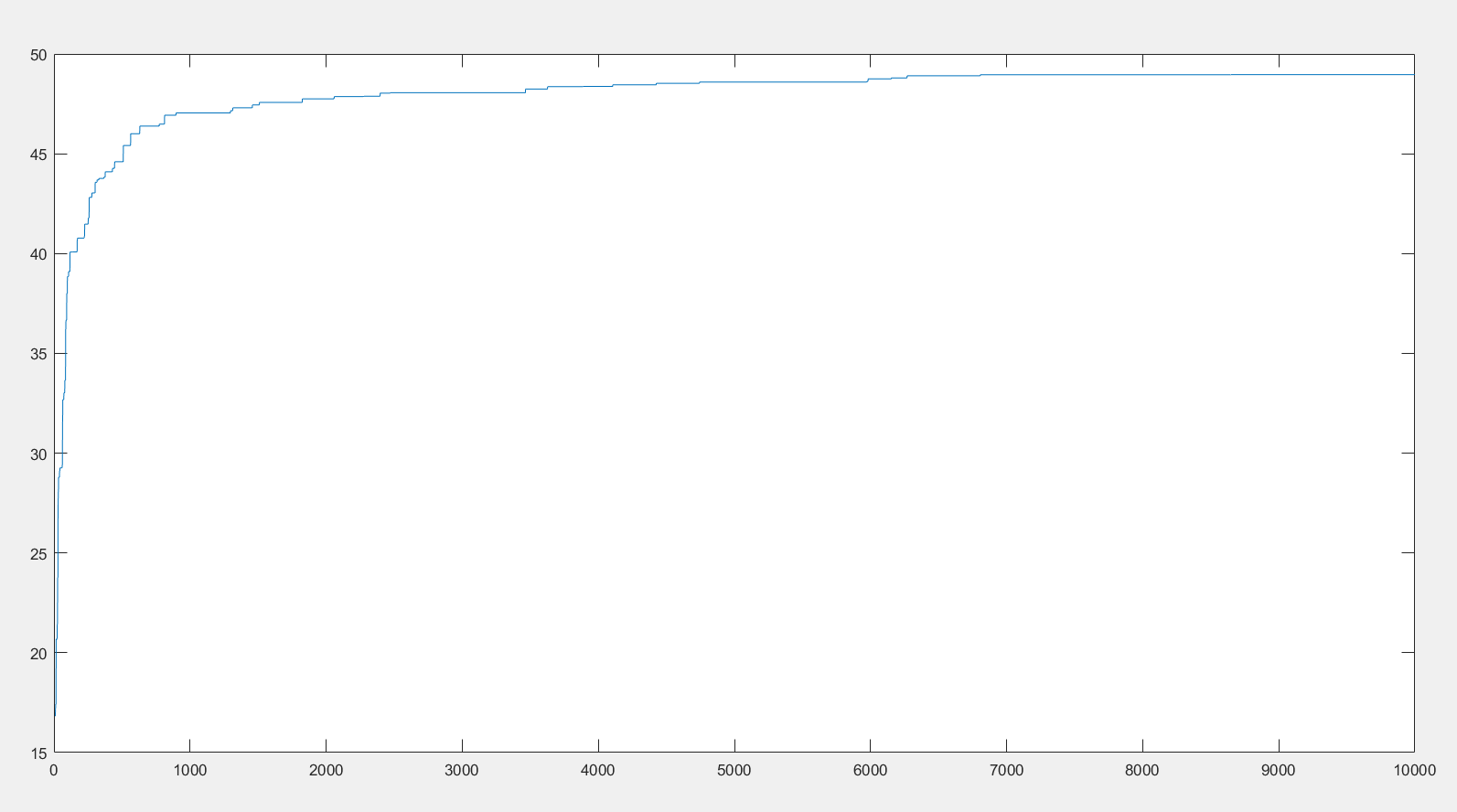
实际的gene values每次跑的结果都不一样,也就是随着初始值变化而变化,但fitness最后基本都收敛到了50左右。