从最简单的进化系统开始研究:EV。
对于一个进化系统来说,它的初始条件有哪些?这些初始条件怎样的影响了结果?这就是我们需要考虑的问题。那么,影响一个系统的因素有哪些呢?
- 种群初始值。是随机初始值吗?初始种群时给定的种子(seed)大小?种群数量?
- 选择的parents数量m。如何选择parents?
- 选择的children数量n。如何选择children?
- mutation function。高斯分布?
- 子代间竞争?子代和父母竞争?全体一起竞争?
- fitness landscape。变量的数量?线性?非线性?
- exploitation和exploration的权衡。 2018/4/12
- 基因的多少(也就是目标函数的维度)。
上面是我自己总结的影响一个系统的因素,也许未来还会继续添加,要想研究一个系统,我们就必须先解决上面的问题。
对于EV来说,它是一个非常简单的进化系统,
EV:
1. 均匀的随机生成m个初始个体。
2. 每次**均匀随机**选择**一个**parent。
3. 每次生成一个子代。
4. 随机选择原先种群的一个个体与offspring做比较,fitness大的留下。
EV1
更具体的EV:
EV:(on a simple fitness landscape)
1. 种群初始大小为10,并且保持10不变。gene values从[-100,100]间随机选择。种子大小为12345。
2. fitness landscape:f(x)=50-x^2。
3. mutation delta=1.0。
下面给出书中这个模型跑的结果:
Simulation time limit (# births): 1000
Random number seed (positive integer): 12345
Using an inverted parabolic landscape defined on 1 parameter(s) with
offset 50.0, with parameter initialization bounds of:
1: -100.0 100.0 and with hard parameter bounds of:
1: -Infinity Infinity
Using a genome with 1 real-valued gene(s).
Using delta mutation with step size 1.0
Population size: 10
Population data after 10 births (generation 1):
Global fitness: max = 43.02033, ave = -4599.12864, min = -8586.50977
Local fitness: max = 43.02033, ave = -4599.12793, min = -8586.50977
Indiv birthdate fitness gene values
1 1 -713.93585 -27.63939
2 2 43.02033 2.64191
3 3 -7449.33398 86.59869
4 4 -6909.38477 83.42293
5 5 -4387.99414 66.61827
6 6 -8499.85352 -92.46542
7 7 -1154.42651 -34.70485
8 8 -5584.96094 -75.06638
9 9 -2747.90723 -52.89525
10 10 -8586.50977 -92.93282

Population data after 20 births (generation 2):
Global fitness: max = 43.02033, ave = -5350.27546, min = -8586.50977
Local fitness: max = 43.02033, ave = -3689.70459, min = -8499.85352
Indiv birthdate fitness gene values
1 1 -713.93585 -27.63939
2 2 43.02033 2.64191
3 18 -659.65704 -26.63939
4 4 -6909.38477 83.42293
5 5 -4387.99414 66.61827
6 6 -8499.85352 -92.46542
7 7 -1154.42651 -34.70485
8 8 -5584.96094 -75.06638
9 20 -713.93585 -27.63939
10 15 -8315.92188 -91.46542

Population data after 1000 births (generation 100):
Global fitness: max = 49.87177, ave = -104.82450, min = -8586.50977
Local fitness: max = 49.87177, ave = 49.87177, min = 49.87177
Indiv birthdate fitness gene values
1 62 49.87177 -0.35809
2 89 49.87177 -0.35809
3 248 49.87177 -0.35809
4 65 49.87177 -0.35809
5 109 49.87177 -0.35809
6 72 49.87177 -0.35809
7 96 49.87177 -0.35809
8 108 49.87177 -0.35809
9 77 49.87177 -0.35809
10 100 49.87177 -0.35809
我自己在电脑上跑的结果是这样的:
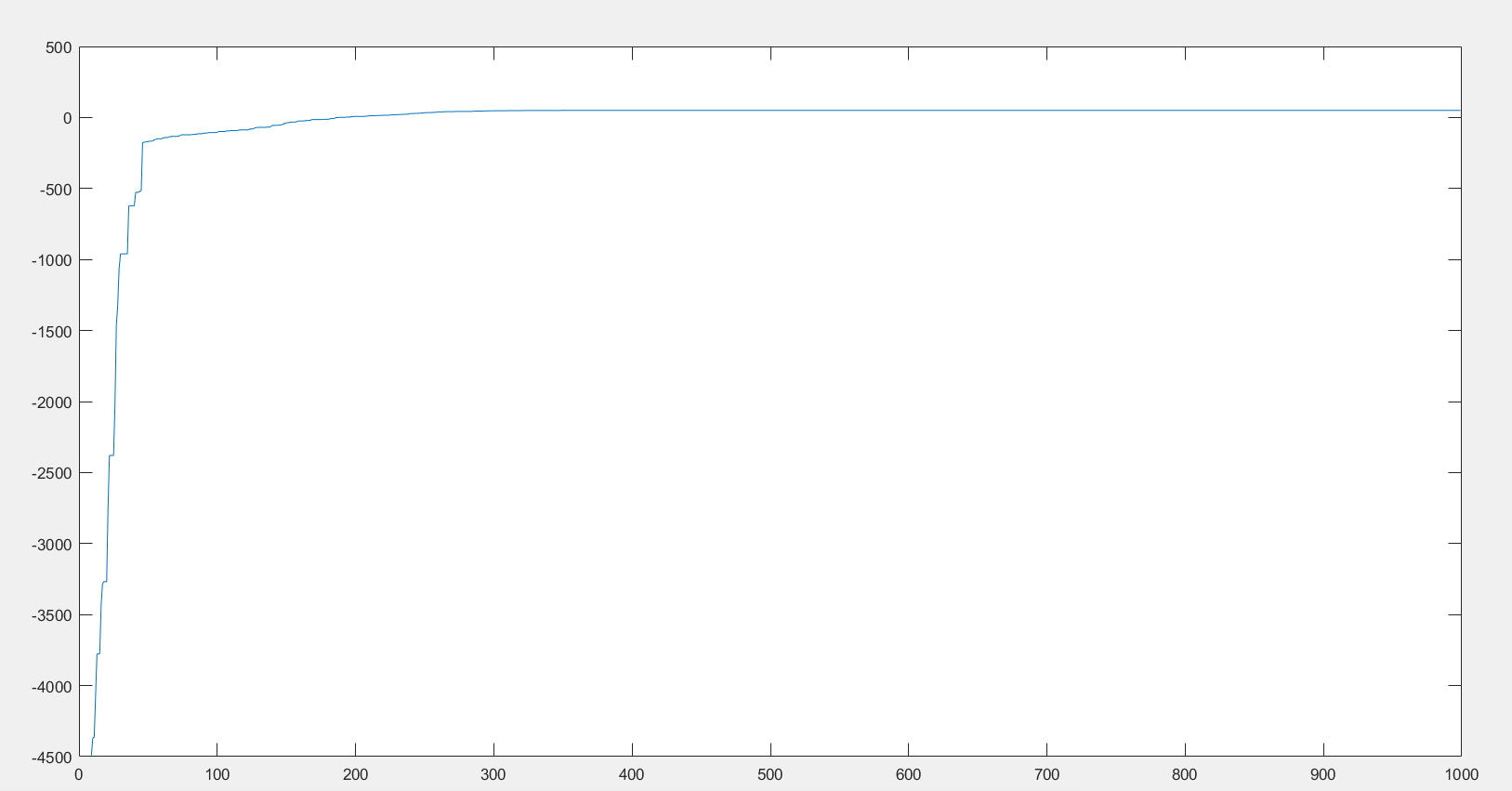
#EV.py
#author:logos
import random
from config import *

pop = []  # 种群
for cnt in range(0, population):
	pop.append(random.uniform(zone[0], zone[1]))

birthdate = []  # birthdate
for cnt in range(0, population):
	birthdate.append(cnt + 1)

fitness = []  # fitness
for cnt in range(0, population):
	fitness.append(fitness_landscape(pop[cnt]))

birthcount=10#用来记录birthdate信息

ave=open("D:\\Evolutionary Computation\\EV one\\ave.txt",'w')
ave.truncate()
while birthcount <= times:
	parent = pop[random.randint(0, population - 1)]  # 从亲代随机选择一个
	child=mutation(parent)  # 子代变异
	fitness_child = fitness_landscape(child)

	race=pop[random.randint(0, population - 1)]#子代与这个个体竞争
	fitness_race=fitness_landscape(race)
	index = pop.index(race)
	if fitness_child > fitness_race:
		birthdate[index] = birthcount
		pop[index] = child
		fitness[index] = fitness_child
	sum = 0.0
	for i in fitness:
		sum += i

	ave.write(str(sum*1.0/population) + ' ')
	print("Indiv birthdate fitness gene values")
	for i in range(0, 10):
		print(str(i+1) + "  " + str(birthdate[i]) + "  " + str(fitness[i]) + " " + str(pop[i]) + "  ")
	print('\n')
	birthcount += 1

ave.close()
和书本相差不大。对于这个简单的模型来说,需要考虑的问题其实也有不少。
- 为什么gene values和fitness总会收敛到同一点?
- gene values和fitness一定会收敛吗?
- mutation delta的大小对最后的结果有什么影响?
对于第一个问题,其实可以发现gene values的值必定是在[-0.5,0.5]之间的,因为此时的mutation delta的值是1,若最后的值不在[-0.5,0.5]区间内,那么一定会有变异存在使得此值的fitness landscape更大,则会代替原本
的个体,那么为什么会收敛到同一点呢?还是因为mutation delta,考虑这样一个情况,某个gene values进入了[-0.5,0.5]区间,另一个数也进入了,在generation趋近于无穷的情况下,大的fitness landscape一定会取胜的,
那么,无论对于什么样的mutation function,最后都会收敛到同一点吗?不是,后面会用正态分布作为mutation function,迭代无数代后gene values不同,这里会收敛到同一点完全就是因为mutation delta=1太特殊了。
EV2
这次的mutation function变得复杂了,不再是delta=1,而是采用正态分布(高斯分布)。
可以看到,用正态分布(step size=1)作为mutation function效果比delta=1好。
#此文件用于设置基本配置
#config.py
import random
import numpy

times=1000#进化代数

population=10#种群大小
zone=[-100,100]#初始值区间

def fitness_landscape(a):
	return 50.0-(a*1.0)*a

def mutation(parent):#mutation
	number=numpy.random.randn()
	return parent+number
- 为什么正态分布效果就会好?一定会更好吗?