5.1 The hiring problem
没啥好说的,很经典的雇佣问题。做一下习题。
5.1-1
Show that the assumption that we are always able to determine which candidate is best, in line 4 of procedure HIRE-ASSISTANT, implies that we know a total order on the ranks of the candidates.
这道题翻译过来就是,如果我们总能确定哪个候选人是最好的,请证明我们知道候选人们的全序。
solution:我们总能确定哪个候选人是最好的,这其实是一个很无敌的条件,这意味着,无论候选人出现的次序如何,我们都能唯一确定一个最佳候选人,说明我们能将任意两个候选人比较得出先后顺序,也就是说,我们知道候选人们的全序。
5.1-2
Describe an implementation of the procedure RANDOM(a,b) that only makes calls to RANDOM(0,1). What is the expected running time of your procedure, as a function of a and b?
Solution:
这道题刚开始的时候读错题了,尴尬,我以为是生成连续性的(0,1)中的值,心想这有什么难的,return a+(b-a)*RANDOM(0,1)不就完事了,后面发现RANDOM函数其实生成的是离散值,RANDOM(0,1)表示生成0和1的概率
各是1/2。然后就有点不会做了..查了下答案,答案的思路是利用RANDOM(0,1)随机生成0,1值作为二进制值,然后证明这个随机生成的二进制值的概率是1/(b-a+1),继而算出期望。
5.1-3
Suppose that you want to output 0 with probability 1/2 and 1 with probability 1/2. At your disposal is a procedure BIASED-RANDOM, that outputs either 0 or 1. It outputs 1 with some probability p and 0 with probability 1 - p, where 0 < p < 1, but you do not know what p is. Give an algorithm that uses BIASED-RANDOM as a subroutine, and returns an unbiased answer, returning 0 with probability 1/2。
Solution: 这道题我也不会做…看了答案觉得自己蠢死了…
unbiased-random(){
	while(1){
		a=biased-random();
		b=biased-random();
		if(a==0&&b==1) return 0;
		if(a==1&&b==0) return 1;
	}
}
其实就是利用了p(1-p)=(1-p)p。
会生成01或10的概率是p(1-p),E(x)=1/2p(1-p)。
5.2 Indicator random variables
这个小节提出了一个叫indicatior random variables的东西,很容易理解,但是却能在我们分析问题的时候使思路和公式变得清晰简洁。
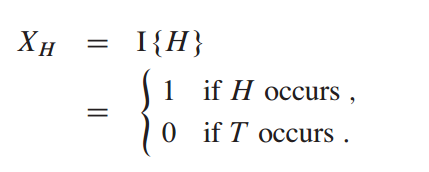
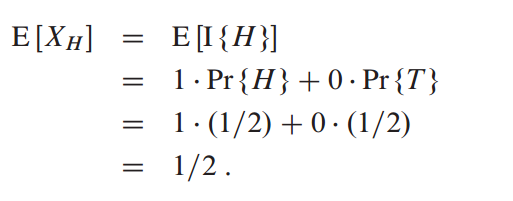
indicator random variables有一个很简单的性质,它的期望等于其中一个事件发生的概率。
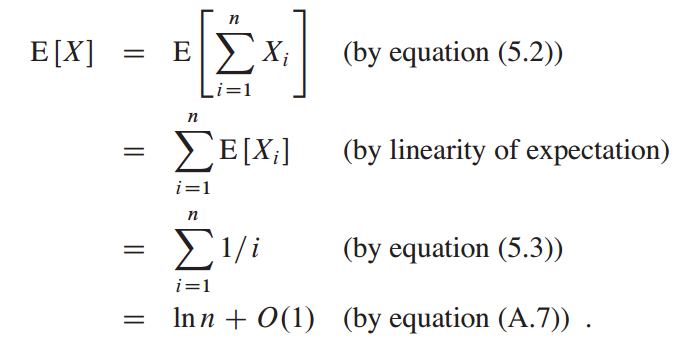
那么hiring problem的次数期望也就很容易得知:
5.2-1
In HIRE-ASSISTANT, assuming that the candidates are presented in a random order, what is the probability that you hire exactly one time? What is the probability that you hire exactly n times?
solution:
这个简单,只雇佣一次,也就是最好的assistant在第一个,这件事发生的概率是1/n,雇佣n次,也就是确定了一种排序:升序,概率是1/n!。
5.2-2
In HIRE-ASSISTANT, assuming that the candidates are presented in a random order, what is the probability that you hire exactly twice?
solution: 这道题可以理解为,如果最好的assistant在第i位,那么前i-1中最好的在第一个。也就对1/(i-1)*n在 i=2到n求和。
5.2-3
Use indicator random variables to compute the expected value of the sum of n dice.
solution: 3.5n
5.2-4
Use indicator random variables to solve the following problem, which is known as the hat-check problem. Each of n customers gives a hat to a hat-check person at a restaurant. The hat-check person gives the hats back to the customers in a random order. What is the expected number of customers who get back their own hat?
solution:
每个人拿到自己帽子的概率为1/n,期望是n*1/n=1.
5.2-5
solution: n(n-1)/4.
Randomized algorithms
这章首先探讨了一下什么是probabilistic analysis和randomized algorithms,probabilistic analysis其实是假设输入是随机的,而random algorithms是不管输入是怎么样的,我在算法的前面强制性的加入一个
随机过程,使得输入随机化。
uniform random permutation
uniform random permutation:所有的permutation都是等可能性的产生。
然后开始介绍两种产生数组的uniform random permutation的方法,
- permute-by-sorting
- permute-in-place
这一章的内容没有很详细看。
Probabilistic analysis and further uses of indicator random variables
The birthday paradox
在一个房间里,如果有两个人同一天生日的概率是50%,至少需要多少人在房间里?
一个房间需要多少人同时在场才能有两个人同一天生日?
Balls and bins
平均情况下我们需要投多少次球才能让每个桶都有一个球?b
平均情况下我们需要投多少次球才能让特定的一个桶有一个球?blnb
Streaks
What is the longest streak of consecutive heads that you expect to see? Θ(logn)
The on-line hiring problem
在前面的hiring problem中,如果我们奉行一个这样的策略:在前i个雇员中不招人,雇用后面的雇员中比前面所有雇员更优秀的。
i取什么值表现最好?i=n/e。