本篇用于备考大二下的算法设计课程,其中会总结已学到的算法,每个算法会给出思想和伪代码,对于复杂的算法会做出详尽的解释。
Introduction
设计算法的5个要求
- Finiteness。terminates after a finite number of steps
- Definiteness。rigorously and unambiguously specified
- Input。valid inputs are clearly specified
- Output。can be proved to produce the correct output given a valid input
- Effectiveness。steps are sufficiently simple and basic
GCD problem
GCD是greatest common divisor的简写,也就是找到两个数的最大公约数。
Euclid’s algorithm
欧几里得算法基于以下的公式实现:gcd(m,n) = gcd(n, m mod n)
//Input:int m,int n
//Output:int
while(n!=0){
	r=m mod n;
	m=n;
	n=r;
}
return m;
欧几里得算法其实用到了后面学的Decrease-and-Conquer思想,要求gcd(m,n)的值,将其减少规模,变成求gcd(n,m mod n)的值。
质数问题
想要判断一个数n是否为质数,很容易想到的是我们只需遍历所有比n小的大于1的数i,判断n mod i==0,复杂度是O(n),其中一个优化是只需判断[2,n^(1/2)]内的数即可,复杂度是O(n^1/2)。
但是如果输入是n,我们要输出一个包含所有小于n的质数的集合呢?
一种简单的解决思路是,对每个小于n的质数运用一次质数检验算法:
//Input:Integer n ≥ 2
//Output:List of primes less than or equal to n
for i=2 to n do
	if(prime(i)) add i to list;
这个算法的复杂度是多少呢?prime(i)的复杂度是O(n^1/2),外面还有一层循环,于是这个算法的复杂度是O(n^3/2)。
其实有另外的解决办法。
Sieve of Eratosthenes
Input: Integer n ≥ 2
Output: List of primes less than or equal to n
for p ← 2 to n do A[p] ← p
for p ← 2 to n do
if A[p] != 0 //p hasn’t been previously eliminated from the list
j ← p* p
while j ≤ n do
A[j] ← 0 //mark element as eliminated
j ← j + p
//copy the remaining elements of A to array L of the primes i ← 0 for p ← 2 to n do
if A[p] != 0
L[i] ← A[p]
i ← i+1 return L
这个算法在做一件什么事情呢?从2开始,将每个质数的倍数标记,剩下的就全都是质数了。 此算法的复杂度分析在这里就不做了。
Algorithm design and analysis process
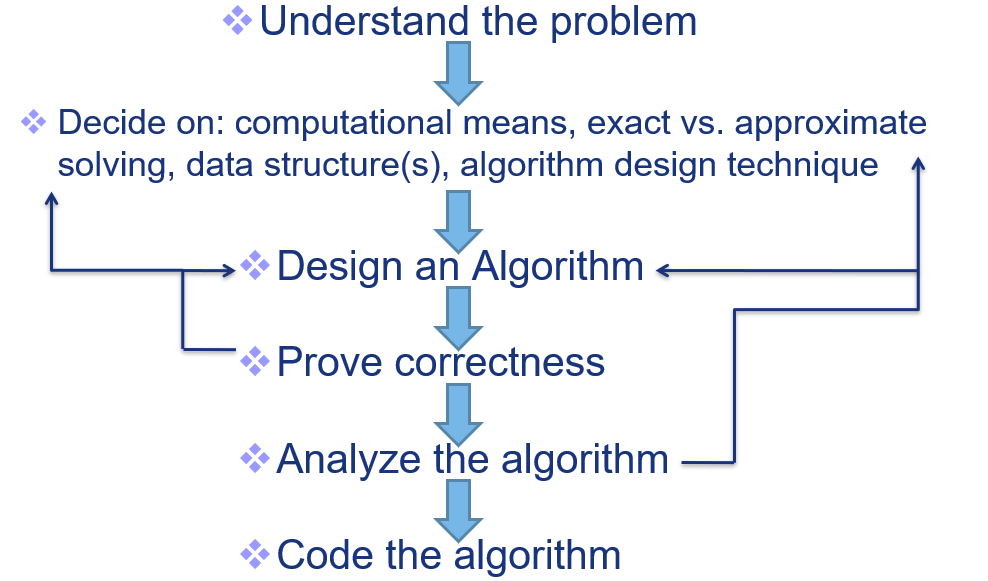
Fundamentals of the Analysis of Algorithm Efficiency
A problem or algorithm with at most polynomial time complexity is considered tractable (or feasible). P is the set of all tractable problems. A problem or algorithm that has complexity greater than exponential is considered intractable (or infeasible). Note that n^1,000,000 is technically tractable, but really very hard. n^(log log log n) is technically intractable, but easy. Such cases are rare though.
Brute Force
Brute-force Sorting
selection sort:
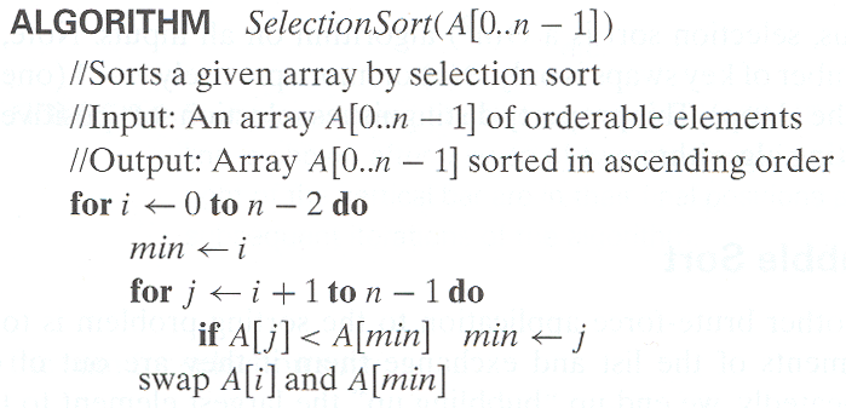
time complexity:Θ(n^2)
bubble sort:
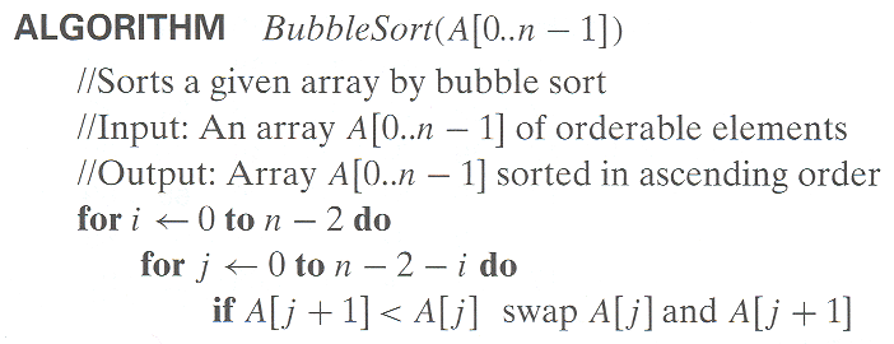
time complexity:Θ(n^2)
Divide-and-Conquer
主定理
主定理的使用请看这篇博文:《Introduction to Algorithm》notes:Three methods for solving recurrences。
MergeSort
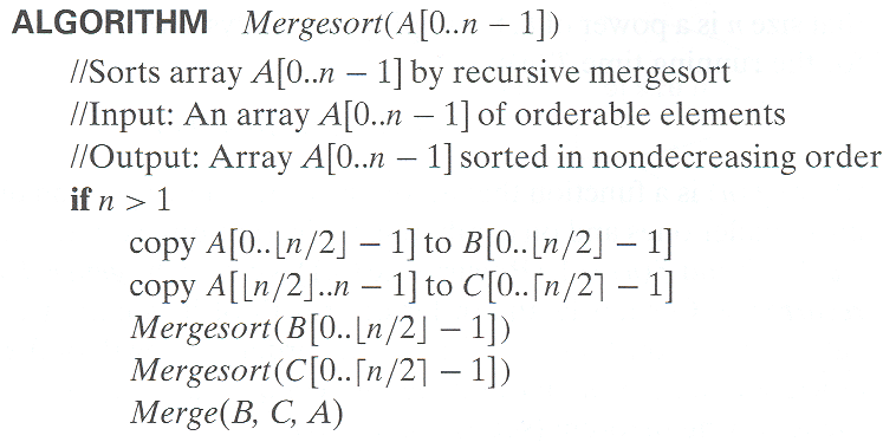
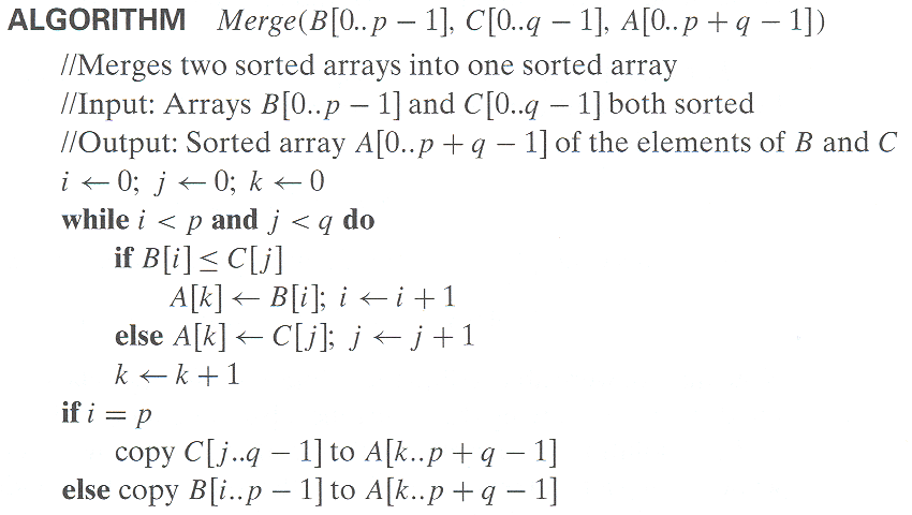
Mergesort无论在最差平均还是最好情况下,time complexity都是Θ(nlogn)。
Quicksort
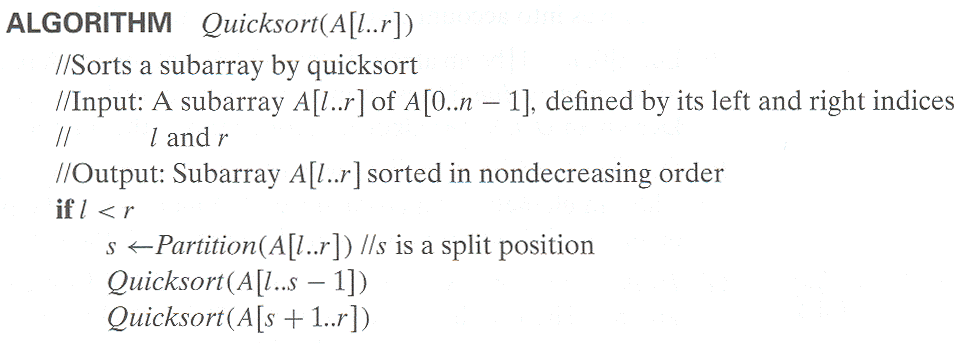
Best case: split in the middle — Θ(n log n)
Worst case: sorted array! — Θ(n2)
Average case: random arrays — Θ(n log n)
Decrease-and-Conquer
Types of Decrease and Conquer
- Decrease by a constant (usually by 1): insertion sort/graph traversal algorithms (DFS and BFS)/topological sorting/algorithms for generating permutations, subsets
- Decrease by a constant factor (usually by half):binary search and bisection method/exponentiation by squaring/multiplication à la russe
- Variable-size decrease:Euclid’s algorithm/selection by partition/Nim-like games
InsertionSort
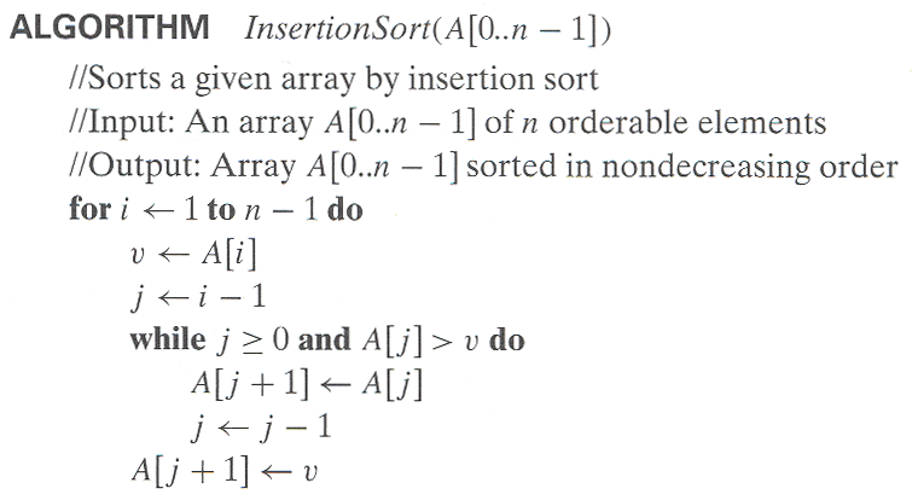
Time efficiency
Cworst(n) = n(n-1)/2∈Θ(n2)
Cavg(n) ≈ n2/4∈Θ(n2)
Cbest(n) = n - 1∈Θ(n) (also fast on almost sorted arrays)
Space efficiency: in-place
Stability: yes
Best elementary sorting algorithm overall
Binary insertion sort
Transform-and-Conquer
AVL树
熟悉好rotation操作就Ok了。 Search and insertion are O(log n) Deletion is more complicated but is also O(log n)
HeapSort
Both worst-case and average-case efficiency: (nlogn)
In-place: yes
Stability: no (e.g., 1 1)